
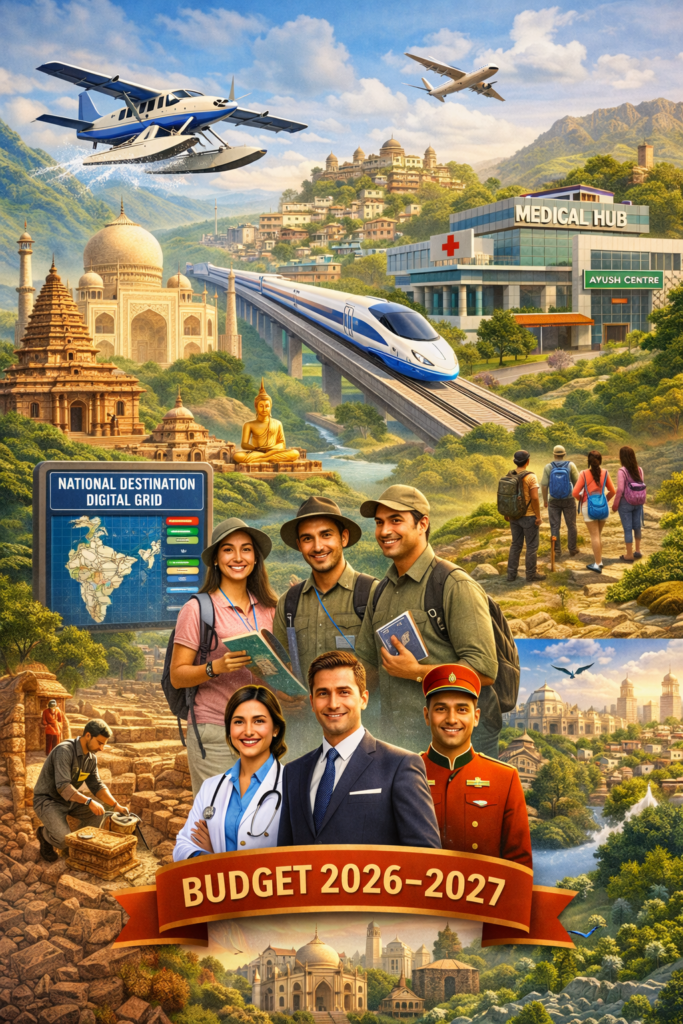
Presenting the Union Budget 2026 to 2027 on February 1, Finance Minister Nirmala Sitharaman placed tourism, connectivity, skilling and destination development at the centre of India’s growth narrative.
The announcements ranged from seven high speed rail corridors and incentives for seaplane manufacturing to medical tourism hubs, heritage site upgrades, guide training, a National Institute of Hospitality, a National Destination Digital Knowledge Grid and a reduction in TCS on overseas tour packages to 2 percent. The measures were widely welcomed by the travel, hospitality and tourism ecosystem, which sees the Budget as a strong signal that tourism is being positioned as a driver of employment, foreign exchange and regional economic growth.
Reacting to the infrastructure push, Ritwik Khare, Founder and CEO of ELIVAAS, said the announcement of seven high speed rail corridors will fundamentally change how travellers plan trips. Faster rail connectivity, he noted, will encourage more frequent, shorter holidays and make weekend and midweek leisure travel far more viable. He added that reduced travel time and cost-effective mobility will open travel to a wider customer base and align well with the growing preference for private villas and flexible stay formats.
KB Kachru, President of the Hotel Association of India and Chairman South Asia at Radisson Hotel Group, said the Budget reflects a strong focus on infrastructure and recognises tourism’s role in employment generation and foreign exchange earnings. He welcomed the proposal for a National Institute of Hospitality and digital initiatives such as the National Destination Digital Knowledge Grid but reiterated the need for infrastructure recognition for hospitality projects, tourism being placed on the concurrent list and GST rationalisation to fully unlock the sector’s potential.
JB Singh, Director at InterGlobe Air Transport and President and CEO of InterGlobe Hotels, said the emphasis on cultural, heritage and nature based destinations along with skilling and institutional capacity building reflects a clear focus on strengthening India’s competitiveness in travel and hospitality.
Surendra Kumar Jaiswal, President of FHRAI, described the Budget as a long-awaited shift that places tourism at the centre of the growth strategy. He said the focus on heritage, spiritual, wildlife and experiential tourism along with skilling initiatives such as training 10,000 guides will unlock India’s potential as a global tourism hub.
Sumit Mitruka, Founder and CEO of Summit Hotels and Resorts, said improved high speed connectivity to Siliguri will reshape how the Northeast is discovered and experienced. He added that structured trekking corridors developed with sustainability and local participation at the core can unlock high value experiential tourism while preserving ecological integrity.
Temjen Imna Along, Tourism Minister of Nagaland, said the proposals around hospitality education, guide training and the digital knowledge grid are especially relevant for culturally rich states where heritage and community tourism are key economic drivers.
Sarbendra Sarkar, Founder and Managing Director of Cygnett Hotels & Resorts, said the focus on hospitality talent, digital platforms and green rail connectivity signals a modern, data driven approach to tourism marketing and mobility.
Pu Lalnghinglova Hmar, Tourism Minister of Mizoram, said the Budget reflects a shift from volume driven tourism to value based, experience oriented models and will open new avenues for local youth and creative professionals.
Pasang Dorjee Sona, Tourism Minister of Arunachal Pradesh, said the Buddhist Circuit scheme and last mile connectivity initiatives will strengthen Arunachal’s role as a civilisational bridge between India and Asia.
Zubin Karkaria, Founder and CEO of VFS Global, said the emphasis on capacity building through infrastructure, skilling and institutional support will strengthen service quality and destination readiness.
Jyoti Mayal, Chairperson of the Travel Hospitality Skill Council, welcomed the National Institute of Hospitality proposal and the guide training programme, calling it transformative for hospitality education and grassroots skilling, while also pointing out the continued need for stronger overseas marketing funds for tourism.
Gaurav Malik, Country Director Indian Subcontinent and Indian Ocean Islands at Agoda, said the Budget recognises changing traveller preferences and combines talent, technology and storytelling to broaden travel beyond large cities.
Aalap Bansal, Partner at KPMG in India, said the focus on medical tourism hubs, archaeological sites and the digital grid signal a shift towards experience management and value capture from India’s civilisational assets.
Sandeep Arora, Director of Brightsun Travel India, said the TCS reduction to 2 percent removes a psychological barrier that had suppressed discretionary international travel and improves cash flow for travellers.
Manoj Bhat, Managing Director and CEO of Mahindra Holidays & Resorts India, said the emphasis on destination development beyond metros and workforce development reflects recognition that tourism growth must be geographically distributed and locally rooted.
Sandeep Basu, CEO of OPO Hotels and Resorts, said enhanced transport, regional connectivity and public private partnerships will improve access to emerging destinations and boost domestic travel.
Shaaz Mehmood, Founder of Medijourn Solutions, said the announcement of five regional medical tourism hubs is a timely step that will strengthen India’s position as a global medical value travel destination.
Shwetank Singh, CEO of Chalet Hotels, said the digital destination registry, archaeological site upgrades and eco trails demonstrate a sophisticated understanding of experiential tourism, while reiterating the sector’s long-standing demand for infrastructure status.
Vikram Kamat, Founder of Vikram Kamats Hospitality, said the National Institute of Hospitality and eco-tourism push will modernise destination management and build a future ready workforce.
Rahul Borude, CEO of StampMyVisa, said the TCS reduction and focus on AI driven skilling and guide training will improve service delivery standards across the sector.
Vineet Kumar Mishra, General Manager of Novotel Guwahati GS Road, said the focus on Tier II cities and guide training will improve visitor experience and boost hospitality demand in gateway cities such as Guwahati.
Giresh Vasudev Kulkarni, Founder of Temple Connect, said the inclusion of temple towns in City Economic Regions and dedicated funding will help transform them into self-sustaining engines of economic growth while preserving cultural sanctity.
Chirag Agarwal, Co-founder and CEO of TravClan, said the TCS reduction is a constructive step for outbound travel businesses and stressed the need for clarity in implementation and easier access to credit for travel companies.
Aditya Sanghi, CEO of Hotelogix, said execution on the ground will determine the long term success of these measures, particularly for midscale hotels in Tier II and III markets that require access to technology and skilled manpower.
Sakshi Sawant, Owner of Maati Nature Resort, said the focus on waterways and coastal connectivity will boost domestic tourism and support local economies.
Industry voices collectively see the Union Budget 2026 as a decisive step that moves tourism from the periphery to the centre of India’s economic planning, backed by connectivity, skills, digital enablement and destination development, while continuing to call for structural reforms that can further accelerate the sector’s growth trajectory.
Key highlights of Budget 2026–27 for the tourism sector
Connectivity and Access
Introduction of incentives to indigenise seaplane manufacturing and a Seaplane VGF Scheme to improve last-mile and remote connectivity.
Development of seven High-Speed Rail corridors between key city pairs to boost inter-city connectivity and tourism mobility.
Destination Development
Proposal to develop 15 archaeological sites (including Lothal, Dholavira, Rakhigarhi, Sarnath, Hastinapur and Leh Palace) into experiential cultural tourism destinations with curated walkways and storytelling experiences.
Launch of a Scheme for Development of Buddhist Circuits across Arunachal Pradesh, Sikkim, Assam, Manipur, Mizoram and Tripura.
Creation of ecologically sustainable tourism trails: mountain trails in Himachal Pradesh, Uttarakhand and J&K; turtle nesting trails in Odisha, Karnataka and Kerala; and bird-watching trails around Pulicat Lake.
Skill Development and Institutions
Upgradation of the National Council for Hotel Management and Catering Technology into a National Institute of Hospitality to bridge academia, industry and government.
A pilot scheme to upskill 10,000 tourist guides across 20 iconic sites through a standardised 12-week hybrid training programme in collaboration with an Indian Institute of Management.
Digital and Cultural Infrastructure
Establishment of a National Destination Digital Knowledge Grid to digitally document places of cultural, spiritual and heritage significance, creating jobs for researchers, historians, content creators and technology partners.
Medical Tourism
Launch of a new scheme to support States in setting up five Regional Medical Hubs in partnership with the private sector, combining healthcare, AYUSH, diagnostics, rehabilitation and facilitation centres to promote India as a medical value travel hub.
Tourism Incentives and Travel Costs
Reduction of Tax Collected at Source (TCS) on overseas tour packages from 5% and 20% to a flat 2% (without any amount stipulation), making international travel more affordable and boosting outbound tour demand.