
The annual assessment also brought India into the global spotlight, with Tulāh Clinical Wellness in Kerala receiving the Innovation Hotel Award for pioneering a new model of preventive wellness hospitality.
Luxury hospitality is undergoing a fundamental transformation, with authenticity, privacy, wellness, sustainability and personalised experiences emerging as the defining pillars of excellence, according to the La Liste Hotels 2026 rankings and industry report released recently.
Founded in Paris in 2015, La Liste has built its reputation by aggregating hundreds of international travel guides, specialist publications, newspapers and consumer-review indices across dozens of languages to create what it describes as a global consensus on hotel excellence. The platform currently evaluates more than 7,300 luxury hotels across over 200 countries and territories, making it one of the hospitality industry’s most comprehensive benchmarking systems.
Unlike traditional rankings based on a single editorial team or inspection programme, La Liste combines multiple trusted sources through a proprietary algorithm that normalises and weights scores to identify consistently acclaimed properties worldwide.
This year’s rankings reveal that while the world’s highest-rated luxury hotels continue to maintain remarkable consistency, the broader industry is rapidly evolving towards experiences rooted in cultural authenticity, emotional connection and destination-led storytelling rather than conventional displays of luxury.
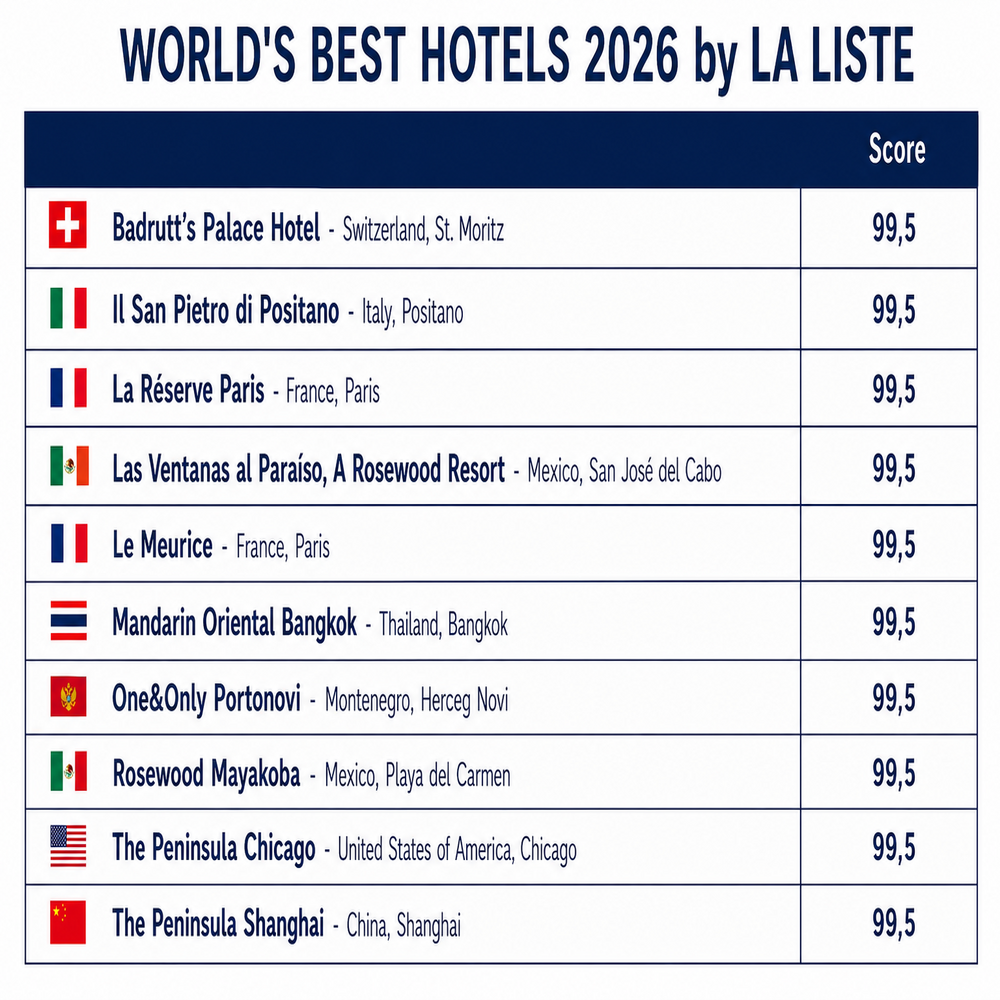
Among the hotels awarded the highest score of 99.5 out of 100 are Badrutt’s Palace Hotel in St. Moritz, Mandarin Oriental Bangkok, Le Meurice and La Réserve Paris, The Peninsula Chicago, The Peninsula Shanghai, Il San Pietro di Positano, Las Ventanas al Paraíso, Rosewood Mayakoba, and One&Only Portonovi. Rather than ranking them competitively, La Liste considers these properties part of an elite global circle representing the highest standards of hospitality.
The report identifies several key trends shaping luxury hospitality. Heritage properties continue to enjoy strong global recognition, while independent hotels are proving capable of competing with international brands through distinctive identities and personalised service. Guests are also placing greater value on privacy, low-density resorts, seamless integration with nature and authentic local experiences.
For India, one of the most notable recognitions came in the Innovation Hotel Award category, where Tulāh Clinical Wellness in Kerala was honoured for combining traditional Ayurveda with advanced medical diagnostics, including metabolic analysis and genetic sequencing. According to La Liste, the property represents a new generation of hospitality that moves beyond conventional wellness retreats towards highly personalised preventive healthcare programmes tailored to individual guests.
Other Special Awards recognised projects that are redefining global hospitality across architecture, sustainability and guest experience. Zannier Île de Bendor in France received the Game Changer Hotel Award for its restoration-led island redevelopment, while The Chancery Rosewood in London was named among the Hotel Openings of the Year. The Emory in London won recognition for design, and Grootbos Private Nature Reserve in South Africa was honoured for its environmental leadership.
Beyond recognising hotels, La Liste’s accompanying industry analysis points to several structural shifts that are redefining luxury hospitality. It notes that competitive advantage is increasingly moving away from physical assets such as grand architecture and large rooms towards intangible qualities including service culture, emotional intelligence, authenticity and strategic vision. Artificial intelligence is also becoming an important operational tool, automating administrative functions and revenue management while allowing hotel staff to focus more on personalised guest interactions.
The report also highlights a widening divide within the hospitality industry. While luxury properties continue to benefit from resilient high-net-worth demand and strong room rates, midscale and economy hotels are facing mounting pressure from inflation, labour shortages and narrowing profit margins. Connectivity is emerging as another critical differentiator, with geopolitical developments and changing aviation networks influencing destination accessibility more than ever before.
Another significant shift identified by La Liste is the evolution of hotel dining. Luxury hotels are increasingly moving away from relying on celebrity chefs as their primary draw and instead developing integrated culinary ecosystems that include destination restaurants, artisan bakeries, signature coffee programmes, cocktail lounges and enhanced in-room dining. The report notes that everyday dining experiences such as breakfast, coffee and poolside menus often leave a more lasting impression on guests than fine-dining tasting menus alone.
Commenting on the findings, Philippe Faure, Founder and President of La Liste, said great hotels are defined not only by architecture or service but also by a culture of hospitality and an identity that evolves across generations. Managing Director Hélène Pietrini added that today’s travellers increasingly seek meaningful experiences and genuine connections with destinations, while Co-founder and Editor-in-Chief Jörg Zipprick said hotel excellence can no longer be measured from a single perspective but through international consensus.
With travellers placing greater emphasis on authenticity, wellness, sustainability and personalised experiences, the La Liste Hotels 2026 report suggests that the future of luxury hospitality will be shaped less by opulence and more by purpose, place and human connection.