
The initiative comes at a time when global ATF prices have surged sharply due to geopolitical tensions in West Asia.
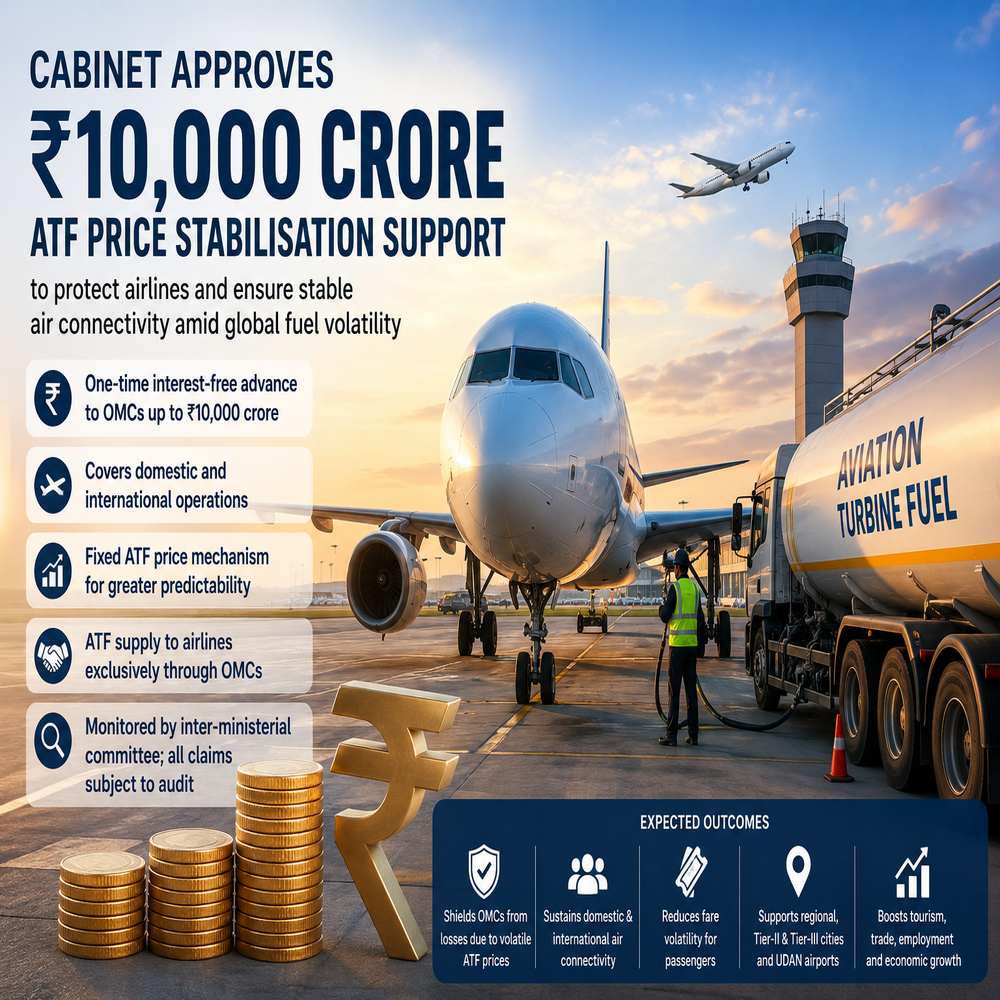
The Union Cabinet, chaired by Prime Minister Narendra Modi on June 3 approved a one-time budgetary support of up to Rs.10,000 crore for Oil Marketing Companies (OMCs) to stabilise Aviation Turbine Fuel (ATF) prices for Scheduled Indian Airlines amid the ongoing fuel price volatility triggered by the West Asia crisis.
The support, which will be provided as an interest-free advance through the Ministry of Petroleum and Natural Gas, is aimed at cushioning airlines from steep fluctuations in global ATF prices while protecting OMCs from mounting losses.
Under the approved mechanism, the government will compensate OMCs whenever international ATF prices exceed the benchmark price fixed under the scheme. The support will be extended to all willing Scheduled Indian carriers for both domestic and international operations.
According to the government, the arrangement is expected to bring greater predictability to airline fuel costs through a fixed-price mechanism, reducing exposure to sudden spikes in ATF prices. The scheme will remain in force for 36 months, subject to annual review or until the entire support amount is fully recovered and settled.
“We are grateful to the Government of India, Ministry of Civil Aviation, Ministry of Petroleum and Natural Gas and the concerned authorities for announcing Aviation Turbine Fuel (ATF) price stabilisation support to Scheduled Indian Airlines.
This timely intervention is a welcome relief that reflects the Government’s understanding of the critical role aviation plays in connecting people and enabling economic growth, while also fostering an environment that empowers airlines to serve passengers better and contribute towards India’s journey as a global aviation hub,” said an IndiGo spokesperson.
A recovery and true-up mechanism has also been built into the framework. Once international fuel prices moderate, the excess support provided to OMCs will be recovered and returned to the Consolidated Fund of India.
The initiative comes at a time when global ATF prices have surged sharply due to geopolitical tensions in West Asia. ATF prices have reportedly risen nearly 2.5 times, from Rs.60.50 per litre in March 2026 to Rs.142 per litre in May 2026. Fuel accounts for nearly 40% of airline operating costs and, during periods of extreme volatility, can rise to as much as 60% of total expenditure.
The crisis has also been aggravated by the closure of Pakistan’s airspace for Indian carriers, resulting in longer flight routes to Europe, North America and Central Asia, thereby increasing fuel consumption and operational costs.
The government said the scheme would help maintain domestic and international connectivity, moderate fare volatility for passengers and support continued services to regional, Tier-II and Tier-III cities, including airports developed under the UDAN scheme.
As part of the arrangement, participating airlines will procure ATF exclusively from OMCs for up to three years under a Memorandum of Understanding (MoU) involving the Ministry of Civil Aviation and the Ministry of Petroleum and Natural Gas.
A Monitoring Committee comprising representatives from the Ministry of Civil Aviation, Ministry of Petroleum and Natural Gas and the Department of Expenditure will oversee implementation, verification of claims, reconciliation and settlement. All claims and recoveries will be subject to audit.
The government believes the measure will have wider economic benefits by supporting employment across airlines, airports, MROs, travel agencies, hospitality and logistics sectors, while also strengthening tourism, trade and India’s connectivity with global markets.