
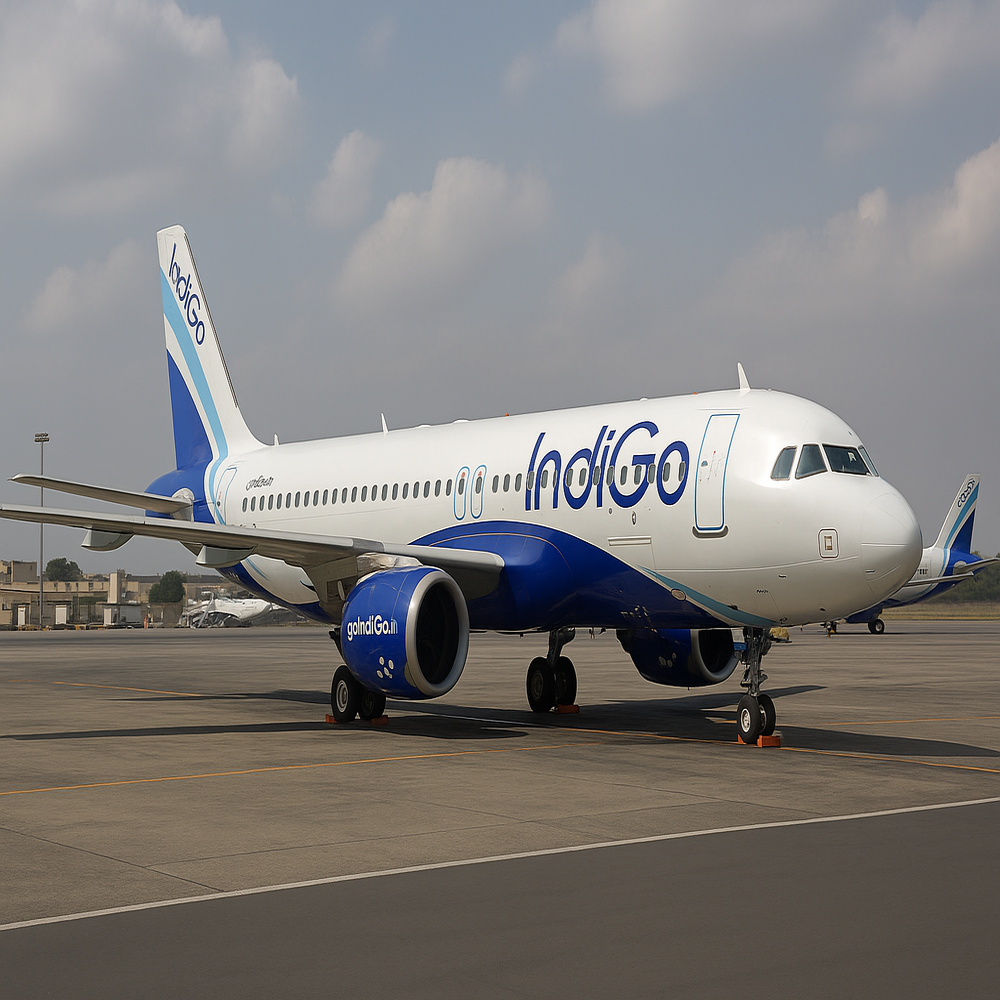
The recent operational crisis at IndiGo, India’s largest airline, has once again exposed the fragility of the country’s aviation ecosystem.
What began as a wave of cancellations, delays, and passenger frustration quickly escalated into a nationwide disruption, revealing how vulnerable India’s skies have become owing to an overreliance on a handful of carriers.
While IndiGo has moved swiftly to stabilise operations; improving on-time performance, restoring flight schedules, and communicating cancellations earlier, the deeper concern lies in the structure of the aviation market itself. India has grown into one of the world’s fastest-expanding aviation markets, yet the number of active domestic airlines has shrunk dramatically, creating a concentration of demand on very few players. When a dominant airline like IndiGo falters, even temporarily, the ripple effects spread across the country with remarkable speed.
IndiGo today commands nearly 60% of the domestic market, operating close to 1,800 flights a day. The scale is impressive, but it also creates a single point of failure. Over the past decade, India has witnessed the grounding or collapse of several carriers from Jet Airways and Kingfisher to Go First, leaving the nation dependent on a shrinking pool of airlines to serve a rapidly growing travelling population. Air India and its subsidiaries, along with SpiceJet and the newer entrant Akasa Air, share the remaining market load. In this environment, when one major airline experiences operational strain, passengers have limited alternatives. Airports become congested, fares spike overnight due to sudden capacity shortages, and customer frustration rises as flights are cancelled or delayed without sufficient communication.
The recent IndiGo situation underscores this challenge. In a market with multiple strong competitors, an individual airline’s crisis would create inconvenience, but the system would have enough elasticity to absorb the shock. In India’s current narrow market, however, a single disruption can cripple connectivity nationwide. Travellers reported long queues, missing baggage, and delayed flight information, while social media flooded with complaints. The Directorate General of Civil Aviation stepped in, demanding corrective actions, but the structural flaw was evident: too much of India’s aviation demand is carried on too few shoulders.
With India projected to become the world’s third-largest aviation market in the coming years, this imbalance between demand and supply is becoming increasingly unsustainable. Passenger numbers have surged, airport infrastructure has expanded, and air travel has become central to business and tourism growth. Yet the number of domestic airlines has reduced rather than expanded. This mismatch is not accidental; it is the result of a challenging environment in which sustaining an airline is both capital-intensive and high-risk. Operating costs in India are among the highest globally, with aviation turbine fuel comprising up to 40% of expenses due to high taxes. Airlines operate in an extremely price-sensitive market, where competitive pressure keeps fares low even as costs rise. Add to this regulatory hurdles, volatile fuel prices, currency depreciation, and access-to-finance issues, and it becomes clear why many Indian airlines have struggled to survive long term.
Despite these challenges, the argument for more domestic airlines is undeniable. When more carriers operate, passengers benefit from competition, better fares, improved services, and more choices. The system becomes more resilient, with enough buffer capacity to absorb operational shocks. Connectivity improves, especially for tier-2 and tier-3 cities, boosting regional development and tourism. More airlines also mean more jobs for pilots, engineers, airport workers, and hospitality professionals. In short, a diversified airline ecosystem is essential for a country of India’s size and economic ambition.
The IndiGo crisis serves as a wake-up call not only for policymakers but also for the industry and investors. India needs to build an aviation environment where new carriers can enter, sustain, and grow. This requires long-term policy stability, rationalisation of fuel taxes, easier access to capital, efficient slot allocation, and continuous expansion of airport infrastructure. India’s UDAN regional connectivity scheme has had some success in opening new routes, but without a strong base of financially stable airlines, its potential remains underutilised. Encouraging regional carriers, creating an investor-friendly regulatory climate, and giving airlines the confidence to expand fleets and staffing are essential steps toward a healthier market.
IndiGo, to its credit, has demonstrated a willingness to respond swiftly to crises. The airline has improved its on-time performance significantly from around 30% to 75% in just a day; restored more than 1,650 flights, and prioritised customer communication by scheduling cancellations earlier. Refund and baggage processes have been accelerated, and ground teams are working around the clock to support travellers. But while these actions are necessary and commendable, they do not resolve the fundamental issue: a system heavily dependent on a single airline is inherently vulnerable, no matter how efficient that airline may be.
This episode also highlights an important reality for passengers: as long as the market remains concentrated, disruptions will continue to have disproportionate effects. The collapse of Jet Airways and the grounding of Go First left enormous gaps in capacity, which were quickly absorbed by remaining airlines, driving market concentration even higher. The government and regulators now face a choice to continue with a highly concentrated market that risks periodic nationwide disruptions or foster an environment that encourages more airlines to enter, survive, and compete.
For India’s aviation dreams to reach their full potential, the country must treat the IndiGo crisis not merely as an operational breakdown but as a signal. A vibrant aviation sector cannot depend on two or three airlines; it requires a broad, competitive landscape where no single carrier is indispensable. A resilient sector is one where disruptions are localised, not national; where customers have choices; and where competition drives innovation and service excellence.
The path forward is clear. India must create conditions for more airlines to thrive and existing ones to strengthen, ensuring that one company’s crisis does not become a countrywide aviation emergency. The IndiGo episode may soon fade from headlines, but its lesson about the risks of concentration and the need for diversification should not be forgotten. India’s aviation future depends on it.